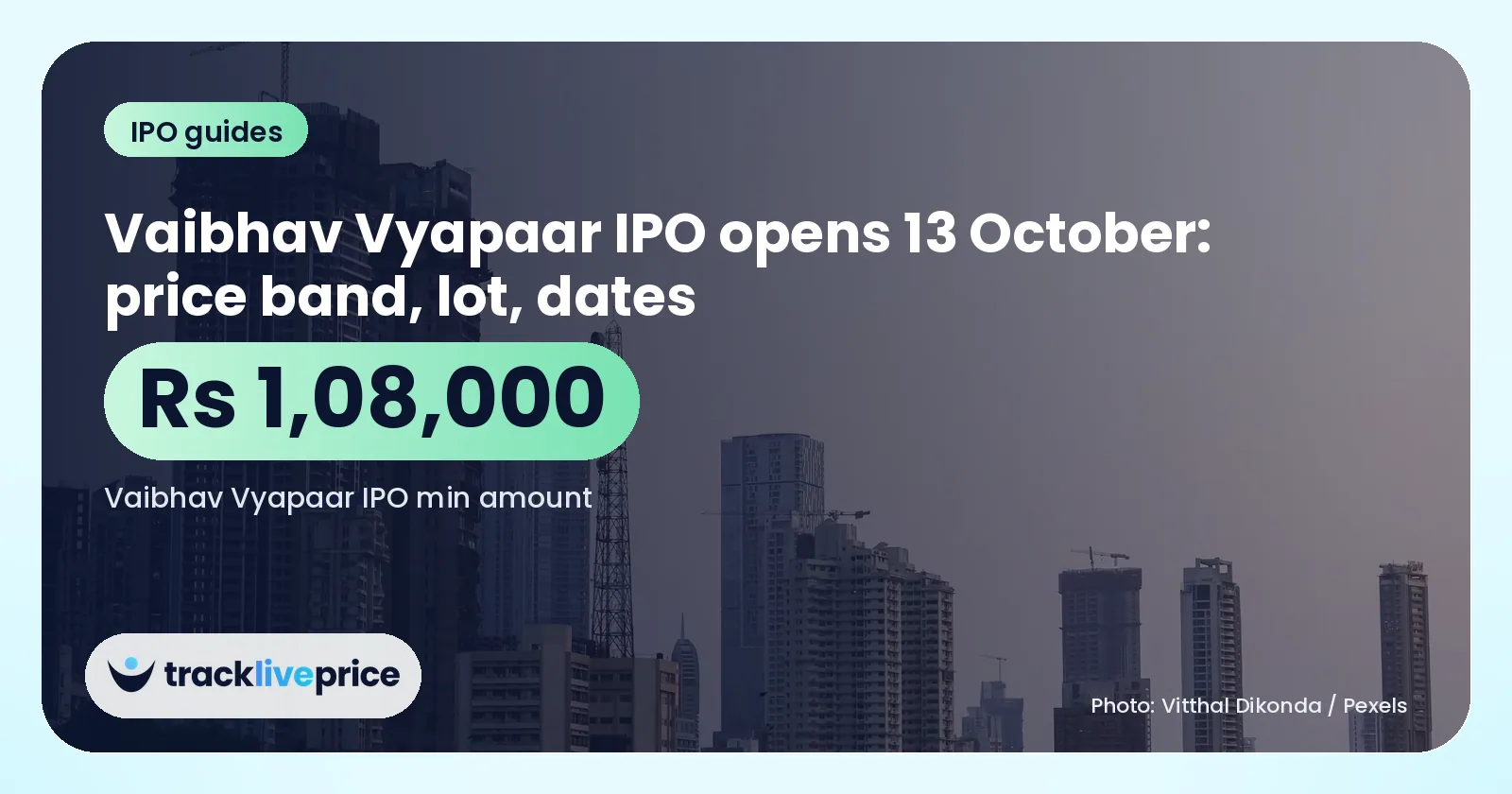
One lot of the Vaibhav Vyapaar Limited IPO costs Rs 1,08,000 at the upper band. Bidding opens on Tuesday, 13 October 2026 and closes on Thursday, 15 October 2026. Our issue record lists it as a book-built SME issue on NSE Emerge, with a price band of Rs 51 to Rs 54 per share and a lot of 2,000 shares.
We read the record at 11:34 IST on 13 October 2026, when its status was Active. The figures below carry that time. The per-issue page is at the Vaibhav Vyapaar IPO page.
Price band, lot size and minimum amount
For SME issues the individual investor category usually bids for 2 lots. The amount you need therefore depends on the category rules in the red herring prospectus (RHP), which we link in the sources. The table shows the amounts at the upper band.
Amounts at the upper band, from our IPO record read at 11:34 IST on 13 October 2026. Assumes bids at the upper band. Check the RHP for category limits.
| Item | Working | Value |
|---|---|---|
| Lot size | from our IPO record | 2,000 shares |
| Upper price band | from our IPO record | Rs 54 per share |
| Minimum amount, one lot | 2,000 x Rs 54 | Rs 1,08,000 |
| Two lots, usual SME individual category bid | 2 x Rs 1,08,000 | Rs 2,16,000 |
Example figures, not today's rates.
Try it: IPO Lot Size and Minimum Investment Calculator lets you pick this IPO from our records and enter a number of lots, and shows the amount at the upper band.
Issue structure and parties
The issue record describes a fresh issue of up to 77,96,000 equity shares, including a market maker portion of 3,90,000 shares and an anchor allocation of 22,00,000 shares. The lead manager is Getfive Advisors Private Limited and the registrar is Kfin Technologies Limited. The RHP sets out the objects of the issue and the risk factors.
A second issue, HD Fire Protect, also opens on 13 October. Its dates and price band are in a separate post, and the two issues have different records, dates and lot sizes.
Expected dates under T+3
SEBI's circular of 9 August 2023 requires listing within three working days of the closing date. Counting from the closing day T, Thursday, 15 October 2026, the expected allotment, refund and listing dates are in the table. Tuesday, 20 October (Dussehra) is in the NSE holiday list, so it is skipped in the count. The dates are expected, and the exchange notice gives the confirmed listing date once it is published.
- TBidding closesThu, 15 Oct 2026
- T+1Basis of allotmentFri, 16 Oct 2026
- T+2Refunds and share creditMon, 19 Oct 2026
- T+3Listing and tradingWed, 21 Oct 2026
Expected dates under the SEBI T+3 timeline, counted in working days from the closing date. Holidays from our NSE holiday list. Dates are expected, not confirmed by the exchange.
| Step | Working day | Date in this example |
|---|---|---|
| Bidding opens | Tuesday | 13 Oct 2026 |
| Bidding closes (T) | Thursday | 15 Oct 2026 |
| Basis of allotment (T+1) | Friday, first working day after T | 16 Oct 2026 |
| Refund and unblocking (T+2) | Monday, weekend skipped | 19 Oct 2026 |
| Listing and trading (T+3) | Wednesday, because Tuesday 20 Oct is a holiday in our NSE holiday list | 21 Oct 2026 |
Example figures, not today's rates.
How we calculated this: the bidding dates, price band and lot size come from our stored IPO record. The minimum amount is the lot size times the upper price band. The T+1, T+2 and T+3 dates count working days after T, skipping weekends and the dates in our NSE holiday list. Source: TrackLivePrice stored IPO records.
Common mistakes
- Using the upper band as the price you will pay. The final price is set through the book-building process, as the RHP describes.
- Using the mainboard Rs 2,00,000 retail limit for an SME issue without checking the category rules in the RHP.
- Counting T+3 in calendar days. The count uses working days, so weekends and holidays are skipped.